


We produce custom springs and wireforms. We do not stock standard parts.
We produce custom springs and wireforms. We do not stock standard parts.


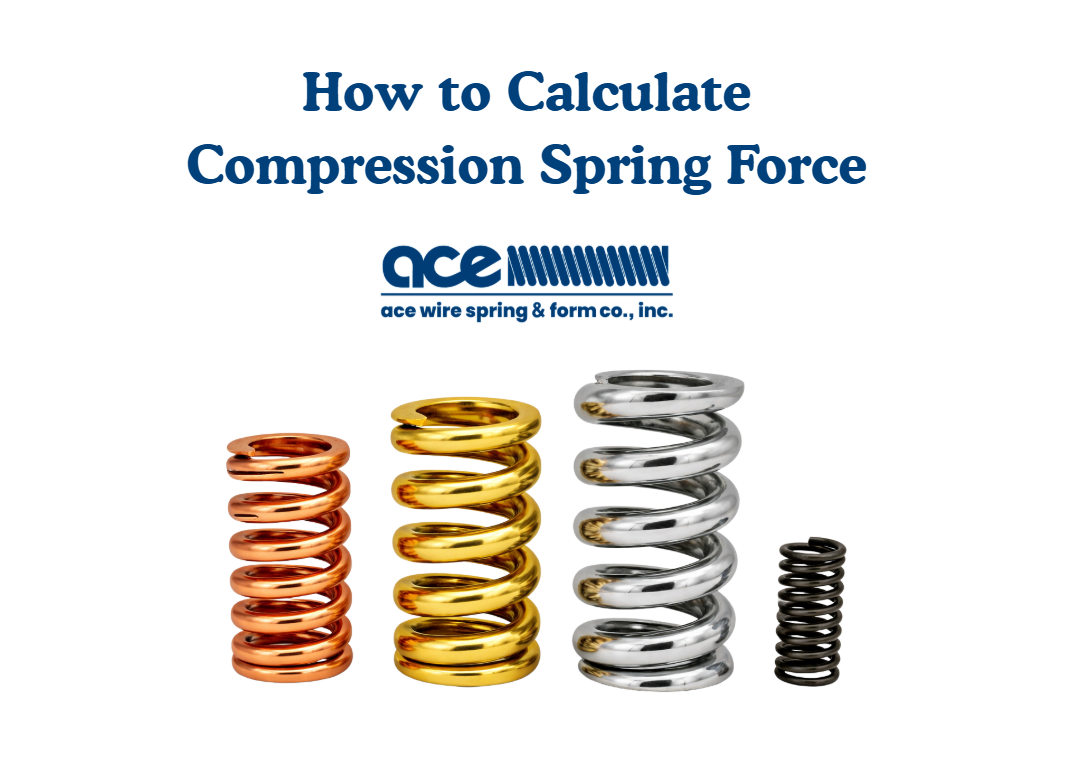
Compression spring force refers to the amount of load a spring exerts when it is compressed. This force is critical in determining how a spring will perform in real-world applications, whether it is absorbing impact, maintaining pressure, or returning a component to its original position.
If the force is miscalculated, the spring will not perform as expected. It may fail early, apply too much stress to surrounding components, or not generate enough force to function properly. That is why accurate calculation is essential in any application involving compression springs.
The force of a compression spring is calculated using a simple relationship between spring rate and deflection. The formula is:
Force equals Spring Rate multiplied by Deflection
Spring rate is the amount of force required to compress the spring by a specific distance, typically measured in pounds per inch. Deflection is the distance the spring is compressed from its free length.
This relationship allows you to predict how much force a spring will generate under a given load.
Spring rate defines how stiff a compression spring is. A higher spring rate means the spring requires more force to compress, while a lower spring rate means it compresses more easily.
In practical terms, spring rate determines how the spring responds under load. In high load applications, a higher spring rate may be required to prevent excessive movement. In applications requiring flexibility or cushioning, a lower spring rate may be more appropriate.
Choosing the correct spring rate is one of the most important factors in ensuring proper spring performance.
Deflection is the amount a spring compresses under load. It is calculated by subtracting the compressed length from the free length of the spring.
Accurate measurement of deflection is critical. Even small errors can result in incorrect force calculations, which can lead to performance issues in the final application.
It is also important to understand that springs should not be compressed beyond their intended working range. Over-compression can lead to permanent deformation or early failure.
Consider a compression spring with a spring rate of 50 pounds per inch. If that spring is compressed by 2 inches, the resulting force can be calculated by multiplying the spring rate by the deflection.
In this case, 50 multiplied by 2 results in 100 pounds of force.
This example illustrates how quickly force increases as deflection increases, which is why precise calculations are necessary when specifying a spring.

While the formula is straightforward, several factors influence how a compression spring performs in real-world conditions.
Material selection plays a major role in determining strength, flexibility, and resistance to fatigue. Wire diameter affects the stiffness of the spring, with thicker wire producing a higher spring rate. The number of coils impacts how the spring compresses and distributes load. Environmental conditions such as temperature, moisture, and exposure to chemicals can also affect performance over time.
Each of these variables must be considered when calculating and applying compression spring force in an industrial setting.
Many issues with compression springs can be traced back to poor calculations or incorrect assumptions. One of the most common mistakes is ignoring tolerances, which can result in variations in spring performance. Another is assuming that the spring will behave linearly beyond its intended range, which can lead to failure.
Using incorrect measurements for deflection or failing to account for real-world operating conditions can also result in inaccurate force calculations. These mistakes often lead to costly redesigns or part failure in the field.
Standard calculations are a starting point, but many applications require a more precise approach. Custom compression springs are often necessary when tight tolerances, high cycle life, or specific performance requirements are involved.
Working with a manufacturer that can provide guidance based on application requirements helps ensure the spring performs as intended. This is especially important in critical applications where failure is not an option.
Understanding how to calculate compression spring force is essential for ensuring reliable performance in any mechanical system. While the formula itself is simple, the impact of incorrect calculations can be significant.
Accurate force calculation allows engineers and buyers to select the right spring for the application, reduce failure risk, and improve overall system performance. In industrial environments, that level of precision is not optional, it is required.


"Where it’s always SPRINGTIME!"
Copyright © Ace WIre Spring & Form Company, Inc. All Rights Reserved. Pittsburgh Website Design by Higher Images.


