


We produce custom springs and wireforms. We do not stock standard parts.
We produce custom springs and wireforms. We do not stock standard parts.


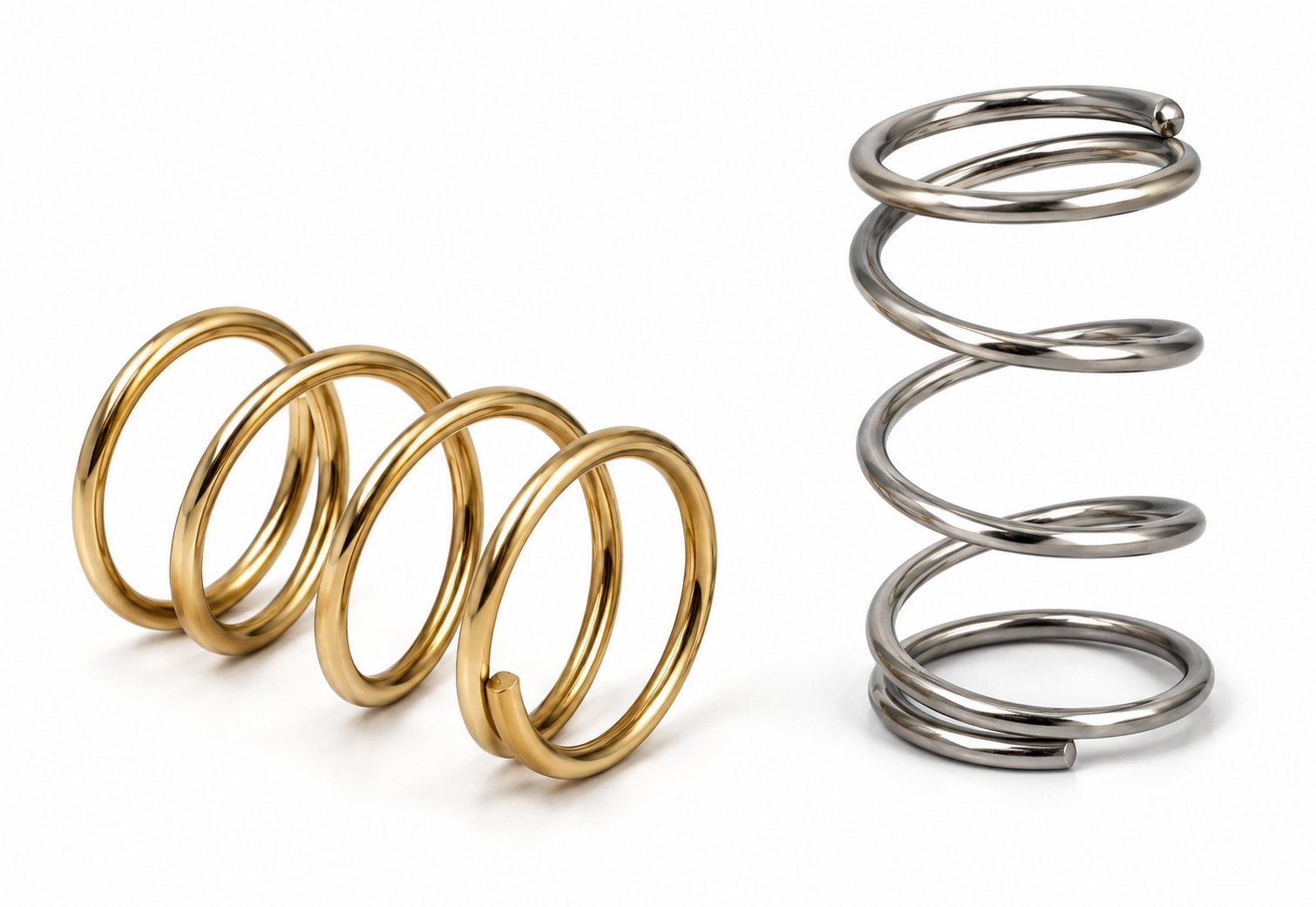
Understanding music wire vs stainless steel springs is important when selecting the proper spring material for industrial applications requiring reliable long term performance. Engineers, procurement specialists, and sourcing teams often compare music wire and stainless steel springs when evaluating strength, corrosion resistance, fatigue life, manufacturability, and overall service life for custom compression springs and other spring types.
Spring material selection directly affects spring reliability, production consistency, operating performance, and long term maintenance requirements. In many industrial environments, choosing the wrong spring material can lead to premature spring failure, increased downtime, corrosion issues, or reduced cycle life. While both music wire and stainless steel spring materials are widely used throughout manufacturing, each material offers different advantages depending on the operating environment and application requirements.
Music wire springs are manufactured using high carbon steel wire designed for high strength and excellent fatigue resistance. Music wire is one of the most common spring materials used in compression springs, torsion springs, and extension springs because of its ability to handle repeated cycling and dynamic loading conditions.
Many engineers select music wire springs for applications requiring high cycle performance, strong mechanical properties, and cost effective production. Music wire is frequently used in industrial equipment, automation systems, mechanical assemblies, transportation equipment, and various commercial products where high strength is required in controlled operating environments.
One of the biggest advantages of music wire springs is their ability to achieve high tensile strength while maintaining excellent fatigue resistance. This makes music wire especially attractive for applications involving repeated deflection cycles over long periods of time. In many cases, music wire springs may support higher stress levels compared to certain stainless steel spring materials.
However, music wire springs are generally best suited for indoor or controlled environments because standard high carbon steel materials may corrode when exposed to moisture, humidity, chemicals, or outdoor operating conditions.
Stainless steel springs are designed to provide improved corrosion resistance while still maintaining reliable mechanical performance. Stainless steel spring materials are commonly selected for applications exposed to moisture, washdown environments, chemicals, humidity, outdoor weather conditions, or marine environments where corrosion protection is critical.
Common stainless steel spring materials include 302 stainless steel, 316 stainless steel, and 17-7 stainless steel. Each material offers different performance characteristics depending on the operating environment and mechanical requirements of the application.
Stainless steel compression springs are widely used throughout industries including medical equipment, food processing, electrical equipment, automation systems, outdoor equipment, marine applications, and chemical processing. In these environments, corrosion resistance often becomes more important than achieving maximum tensile strength.
While stainless steel springs may not always provide the same stress capabilities as music wire springs, their ability to resist corrosion can dramatically improve long term reliability in harsh environments. In many applications, preventing corrosion related fatigue and surface degradation becomes one of the most important factors affecting spring life expectancy.
When comparing music wire vs stainless steel springs for strength, music wire generally provides higher tensile strength and improved fatigue performance in controlled operating environments. Because of its high strength capabilities, music wire is commonly selected for applications involving dynamic loads, repeated cycling, and long fatigue life requirements.
In applications where dimensional space is limited, the higher strength of music wire may allow engineers to achieve required spring forces using smaller or more compact spring designs. This can be especially beneficial in automation equipment, industrial machinery, and mechanical assemblies where space constraints are important.
Stainless steel springs still provide strong mechanical performance, but the primary advantage of stainless steel is environmental durability rather than maximum strength. Engineers evaluating spring material selection must often balance corrosion resistance with stress requirements, fatigue performance, and expected service life.
For many industrial applications, determining whether music wire or stainless steel springs are the better choice depends heavily on the operating environment rather than strength alone.
Corrosion resistance is one of the biggest differences between music wire vs stainless steel springs. Standard music wire springs may corrode relatively quickly when exposed to moisture, salt, chemicals, humidity, or outdoor operating conditions. Surface corrosion can weaken the spring material, create stress concentration points, and significantly reduce fatigue life over time.
In controlled indoor environments, corrosion may not be a major concern, allowing music wire springs to perform extremely well in high cycle applications. However, once moisture or corrosive exposure becomes part of the operating environment, stainless steel spring materials often become the preferred solution.
Stainless steel springs are specifically selected to improve resistance against corrosion and environmental degradation. For example, 302 stainless steel springs provide general corrosion resistance for many industrial applications, while 316 stainless steel springs are commonly selected for marine environments or applications involving higher chemical exposure.
Corrosion resistance becomes especially important in applications involving washdown conditions, outdoor exposure, food processing equipment, medical devices, or electrical enclosures where long term environmental durability is critical.
Fatigue life is another major factor engineers evaluate when comparing music wire vs stainless steel springs. Music wire is well known for excellent spring fatigue resistance and is commonly used in high cycle applications requiring repeated motion over long periods of time.
In properly controlled operating environments, music wire springs may achieve longer fatigue life than certain stainless steel materials due to their higher tensile strength and ability to withstand repeated stress cycles. This is one reason music wire is frequently used in automation systems, industrial equipment, and mechanical assemblies where spring cycling occurs continuously.
However, real world operating conditions greatly affect fatigue performance. Corrosion can significantly accelerate fatigue failure in music wire springs exposed to moisture or harsh environments. Even minor surface corrosion may create weak points that eventually lead to cracking and premature spring failure.
Stainless steel springs may provide better long term durability in corrosive environments because corrosion resistance helps protect the spring surface from environmental damage. When evaluating high cycle compression springs, engineers often consider stress levels, environmental exposure, operating temperatures, and expected service life before selecting the proper spring material.
Operating temperature can also affect spring material performance and long term reliability. Music wire springs are commonly used in moderate temperature environments but may experience limitations when exposed to elevated temperatures for extended periods of time.
Certain stainless steel spring materials may provide improved temperature resistance depending on the application and environmental conditions. In applications involving elevated heat, engineers often evaluate factors such as relaxation resistance, load retention, material stability, and long term mechanical performance.
Temperature exposure becomes increasingly important in industrial applications where springs operate continuously near motors, electrical equipment, heating systems, or production machinery generating sustained heat.
Manufacturing requirements also play a major role when evaluating music wire vs stainless steel springs and wire forms. Engineers and procurement teams often consider production quantities, material availability, dimensional tolerances, lead times, repeatability, and long term manufacturing consistency before selecting a spring material.
Music wire is widely available and often provides cost advantages for medium to high production runs operating in controlled environments. Stainless steel spring materials may involve higher raw material costs, but improved corrosion resistance may reduce maintenance costs, replacement frequency, and downtime over the life of the application.
For custom compression spring manufacturing, balancing material performance with manufacturability is critical. Material selection affects forming behavior, production consistency, stress performance, and long term repeatability across larger production quantities.
In many industrial applications, the lowest material cost does not always produce the best long term value. Spring Engineers frequently evaluate total lifecycle performance rather than focusing only on initial material pricing.
Engineers comparing music wire vs stainless steel springs typically evaluate the complete operating environment before selecting a material. Factors such as corrosion exposure, required cycle life, operating temperature, dimensional constraints, production volume, and long term durability all influence the final material selection process.
Music wire springs are often selected for dry indoor applications requiring high strength and excellent fatigue performance. Stainless steel springs are commonly preferred when corrosion resistance, environmental durability, and moisture exposure become more important than maximum tensile strength.
The best spring material depends on the complete application requirements rather than any single performance characteristic alone. In many cases, successful spring performance depends on balancing strength, environmental resistance, manufacturability, and long term operating reliability.
In many industrial applications, music wire springs provide higher tensile strength and improved fatigue performance compared to standard stainless steel spring materials operating in controlled environments.
Stainless steel springs provide significantly improved corrosion resistance compared to music wire springs, although environmental conditions and alloy selection still affect long term corrosion performance.
Stainless steel springs are generally preferred for outdoor applications because they provide improved resistance against moisture, humidity, and environmental corrosion.
Music wire springs are commonly selected for high cycle applications operating in controlled indoor environments because of their high strength and excellent fatigue resistance.
Understanding music wire vs stainless steel springs helps engineers, procurement specialists, and sourcing teams make better decisions regarding spring performance, corrosion resistance, fatigue life, and long term reliability. Both spring materials offer important advantages depending on the operating environment and application requirements.
Music wire springs are often preferred for high strength, high cycle industrial applications operating in controlled environments. Stainless steel springs provide improved corrosion resistance for outdoor, washdown, chemical, and moisture exposed applications where environmental durability becomes critical.
For custom compression spring manufacturing, selecting the proper spring material plays a major role in achieving reliable performance, manufacturing consistency, and long term application success. Request a spring quote from our team today!


"Where it’s always SPRINGTIME!"
Copyright © Ace WIre Spring & Form Company, Inc. All Rights Reserved. Pittsburgh Website Design by Higher Images.


