


We produce custom springs and wireforms. We do not stock standard parts.
We produce custom springs and wireforms. We do not stock standard parts.


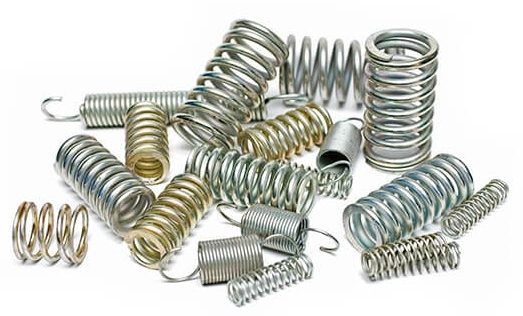
Coil springs are essential components in mechanical systems across every industry. From industrial machinery and transportation equipment to firearms, medical devices, robotics, electronics, and consumer products, coil springs provide controlled force, support, stabilization, and energy management. Although the design of a coil spring appears simple at first glance, its performance is governed by precise engineering principles, material science, and careful manufacturing. Understanding how a coil spring works is critical for selecting or designing springs that perform reliably, meet load requirements, and withstand long-term use.
A coil spring functions by storing mechanical energy and releasing it in a controlled manner. When a spring is compressed, extended, or twisted, mechanical work is applied to the wire. This work creates internal stress within the material, temporarily deforming it. Because spring wire is elastic within its working range, the material attempts to return to its original shape. This return force is what creates the usable mechanical output. The ability of a coil spring to store and release energy is dependent on the wire diameter, coil diameter, number of active coils, material properties, and the type of load applied. Springs operate within an elastic zone, meaning they must return fully to their original shape. If overstressed beyond the elastic limit, the spring may deform permanently or fail prematurely.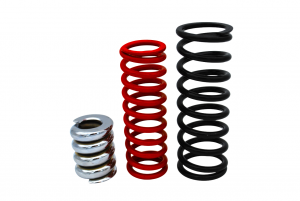
The geometry of a coil spring directly influences its behavior. Our Spring Engineering Team evaluates several parameters when designing or selecting a spring: wire diameter, mean coil diameter, spring index, free length, solid height, and number of active coils. Wire diameter determines the stiffness and load capability. Larger wire is stronger but creates a stiffer spring. Mean coil diameter affects stress distribution; tighter coils create higher stresses. The spring index, which is the ratio of mean diameter to wire diameter, affects manufacturability and performance. A low spring index indicates a tight coil that may be difficult to produce and more prone to stress concentration. Free length defines the distance between the ends when the spring is not loaded. Solid height is the minimum height when fully compressed. The number of active coils controls deflection and spring rate. These geometric characteristics determine how much force a spring can produce, how far it can deflect, and how long it will last under repeated cycling.
Spring rate, often represented as k, defines how much force is required to compress a spring by a certain distance. A higher spring rate means the spring is stiffer and requires more force to move. Spring rate is influenced by wire diameter, coil diameter, material modulus, and active coil count. In compression springs, the relationship between force and deflection is generally linear within the working range. In torsion springs, torque increases with angular deflection. Extension springs increase tension as they stretch. Understanding spring rate allows engineers to calculate the exact force needed for a specific application, ensuring predictable and repeatable performance. Incorrect spring rate is a common cause of system failure, often leading to overstressing, insufficient force output, or premature fatigue.
The ability of a coil spring to function depends on material elasticity, tensile strength, fatigue resistance, and resilience. Different materials behave differently under stress. Music wire offers high strength and excellent fatigue life but is not corrosion resistant. Stainless steel provides corrosion resistance and stability but lower tensile strength. Chrome silicon is used for high-stress, high-temperature applications. Phosphor bronze and beryllium copper offer electrical conductivity and corrosion resistance. Inconel and other high-performance alloys are chosen for extreme temperatures and aggressive environments. Elastic modulus and shear modulus are critical engineering values that determine how much the wire will deform under load. Selecting the right material ensures that the spring performs consistently, does not weaken prematurely, and matches environmental demands such as heat, chemicals, or moisture.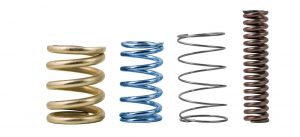
When a coil spring is loaded, internal stresses develop along the wire. In compression springs, the wire experiences torsional stress as the coils twist under the applied load. The highest stress typically occurs on the inside surface of the coil. Stress distribution affects fatigue life and performance consistency. If a spring is designed with excessive stress levels or if the material cannot handle repeated cycling, cracks will form and lead to failure. Proper stress relief during manufacturing helps remove internal residual stresses created during coiling. Engineers must ensure that the working stress does not exceed safe limits, especially in applications with millions of cycles or high shock loads.
Manufacturing precision plays a major role in how effectively a spring functions. Variations in coil diameter, pitch, straightness, end configuration, and heat treatment can significantly impact performance. CNC coiling allows for consistent, repeatable production of custom springs with tight tolerances. Heat treatment and stress relieving stabilize the material after forming. Grinding ensures that compression spring ends sit squarely and distribute loads evenly. Surface finishing, plating, or shot peening may be required to enhance fatigue life or protect against corrosion. Poor manufacturing practices can create stress concentrations, uneven force output, and unpredictable behavior under load. A spring only performs as well as it is manufactured.
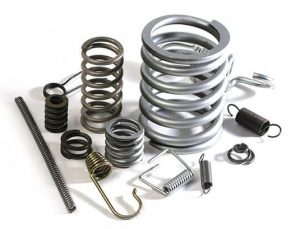
Although all coil springs operate on the principle of energy storage and release, each type functions differently. Compression springs resist force when compressed. They are used in machinery, valves, industrial equipment, firearms, and transportation systems. Extension springs stretch under load and create tension. They are used in levers, assemblies requiring return force, and mechanical linkages. Torsion springs generate torque by twisting their legs around the coil body. They are common in hinges, latches, firearm components, and counterbalance systems. Each spring type requires unique considerations in design, stress levels, material selection, and manufacturing.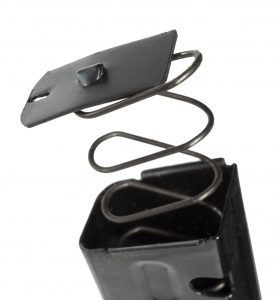
Several factors can cause a spring to lose function: excessive stress, improper material, corrosion, misalignment, incorrect installation, or manufacturing defects. Springs may fatigue and lose their ability to return to their original length. Corrosion can weaken the wire and lead to cracking. Overloading can permanently deform or break coils. Misalignment may create unintended bending or uneven loading. Poor surface quality accelerates fatigue. Ensuring proper engineering, manufacturing, and installation is essential for long-term performance.
Custom coil springs are designed specifically for the load, space constraints, environment, and performance requirements of an application. Generic or off-the-shelf springs rarely match the exact needs of engineered systems. Custom springs allow optimization of material, geometry, stress levels, finish, and coil configuration. Engineers benefit from predictable performance, longer service life, enhanced durability, and reduced risk of failure. Custom manufacturing also supports prototyping, iterative development, and precise control over tolerances.
The longevity of a coil spring depends on managing stress levels, choosing the appropriate material, applying proper finishes, and ensuring accurate manufacturing. Springs operating within safe stress limits exhibit predictable fatigue curves. Corrosion-resistant materials or coatings protect against environmental damage. Quality manufacturing ensures uniformity and load consistency. Proper installation prevents bending forces or misalignment. When all these factors align, coil springs deliver long-term, reliable performance even in demanding industrial conditions.
A coil spring works by storing and releasing energy through controlled deformation of its coils. Its ability to perform depends on geometry, material selection, stress distribution, and manufacturing precision. Understanding how coil springs function enables engineers to design and specify components with the right performance characteristics, ensuring reliability in any application.
For engineering support or custom coil spring manufacturing, contact Ace Wire Spring & Form Co. for design assistance, prototypes, and production-quality springs built in the USA.


"Where it’s always SPRINGTIME!"
Copyright © Ace WIre Spring & Form Company, Inc. All Rights Reserved. Pittsburgh Website Design by Higher Images.


