


We produce custom springs and wireforms. We do not stock standard parts.
We produce custom springs and wireforms. We do not stock standard parts.


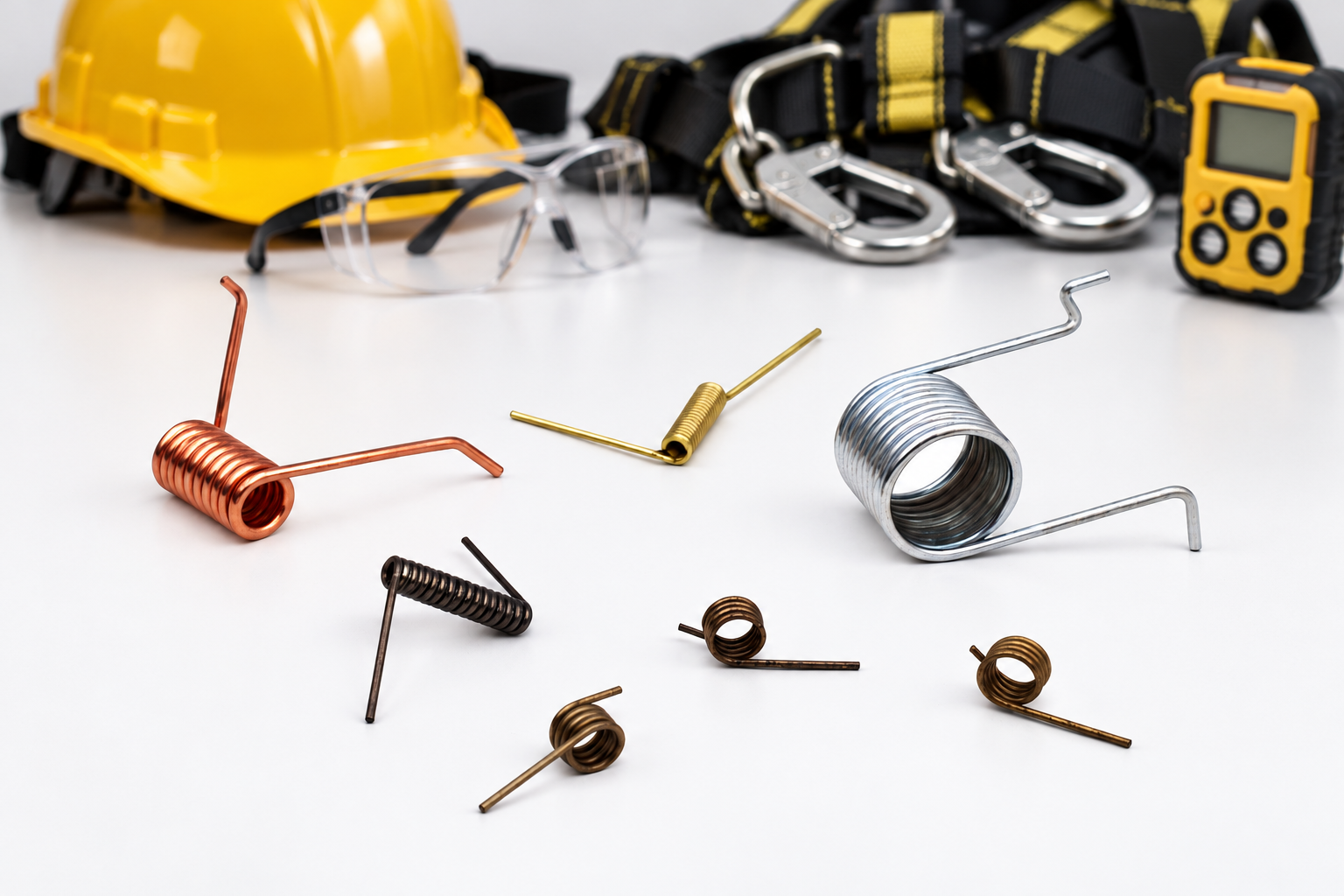
Safety equipment springs can perform important mechanical functions within industrial safety devices, protective equipment, mechanical releases, locking mechanisms, and other assemblies designed to operate under specific conditions. Depending on the application, springs may provide return force, maintain tension, control movement, engage a mechanical component, or support the operation of a safety mechanism.
For safety equipment manufacturers, finding the right spring supplier involves more than identifying a component with the correct dimensions. Springs used in safety related applications must be manufactured to the customer’s specified requirements, with particular attention to materials, tolerances, mechanical performance, and production consistency.
Ace Wire Spring & Form Co., Inc. manufactures custom compression springs, extension springs, torsion springs, and wire forms for OEM and industrial manufacturers. Our team works from customer drawings, specifications, and physical samples, providing engineering assistance, prototype development, and recurring production manufacturing for qualified projects.
Safety equipment springs are mechanical spring components incorporated into equipment or assemblies that perform protective, positioning, locking, releasing, or other mechanical functions.
The type of spring depends on the equipment and the movement required.
A mechanical release may incorporate a compression spring that provides force along a linear path. A rotating locking mechanism may require a torsion spring. An assembly requiring tension between attachment points may use an extension spring, while another product may incorporate a specially formed wire component.
The important consideration is that the spring must be designed and manufactured around the actual mechanical requirements of the assembly.
For OEM manufacturers, this generally means providing the spring manufacturer with the engineering specifications necessary to produce the component consistently.
Safety springs can be incorporated into industrial safety equipment, protective mechanisms, equipment enclosures, locking assemblies, retracting mechanisms, emergency release devices, and other manufactured products.
Depending on the design, springs may be used to return a mechanism to position, maintain mechanical engagement, provide controlled movement, or support an assembly that must operate when activated.
Applications can also vary significantly in their operating environments.
Some equipment operates indoors under relatively controlled conditions, while other products encounter moisture, vibration, temperature changes, contaminants, or repeated mechanical cycling.
These conditions can influence the material, spring geometry, load requirements, and manufacturing specifications.
Because safety equipment can have critical performance requirements, the OEM should define the necessary operating characteristics and validate the finished assembly for its intended application.
Compression springs can be used in mechanical assemblies that require resistance to compressive force, positioning, or controlled return movement.
Potential applications include spring loaded mechanisms, mechanical controls, release assemblies, locking components, and other devices that require force along a linear path.
Important specifications can include wire diameter, coil diameter, free length, solid height, spring rate, load at specified heights, end configuration, material, and dimensional tolerances.
The surrounding assembly also needs to be considered.
A compression spring must operate within the available space while providing the required force throughout its intended movement.
For an established OEM component, a complete engineering drawing generally provides the strongest starting point for manufacturing.
Ace manufactures custom compression springs to customer specifications for qualified OEM and industrial applications.
Extension springs operate under tension and can be used in assemblies requiring pulling force, return movement, or maintained tension between components.
These springs typically incorporate hooks, loops, or other attachment features that connect the spring to the surrounding equipment.
The attachment configuration is an important part of the design because it determines how force is transferred between the spring and the mechanism.
When sourcing a custom extension spring, engineers should communicate working lengths, loads, initial tension, end configurations, material requirements, dimensional tolerances, and other relevant specifications.
Operating movement should also be considered. Misalignment or unintended bending at an attachment point can introduce stresses that affect spring performance.
Ace can review extension spring drawings and specifications to determine whether the component fits our manufacturing capabilities.
Torsion springs provide rotational force and can be incorporated into mechanical assemblies that use pivots, levers, rotating releases, hinges, or locking mechanisms.
These springs are typically designed around the movement and geometry of the surrounding components.
Important specifications can include torque, degrees of rotation, direction of wind, body dimensions, leg configuration, shaft clearance, material, and tolerances.
Leg geometry deserves particular attention because the spring legs transfer torque between the spring body and the assembly.
A spring may fit physically into a mechanism but still fail to provide the intended performance if the loading direction, leg geometry, or operating range is incorrect.
Ace manufactures custom torsion springs from customer drawings and specifications and can provide manufacturing feedback during qualified product development projects.
Not every component used in safety equipment is a conventional coil spring.
Custom wire forms can be manufactured into clips, hooks, retainers, brackets, locking components, and other specialized shapes used within mechanical assemblies.
These components are designed around the requirements of the customer’s product rather than selected from standardized inventory.
A wire form drawing may specify multiple bends, angles, radii, attachment features, material requirements, and dimensional tolerances.
The shape of the component is particularly important because it determines how the wire form interacts with surrounding parts.
Ace manufactures custom wire forms using specialized forming equipment and supports qualified projects from prototypes through recurring production.
For equipment manufacturers requiring several spring and wire form components, working with one custom manufacturing source may also simplify supplier coordination.
Mechanical reliability is an important consideration when specifying safety equipment springs, particularly when the component contributes to a protective or release function.
A spring may be required to provide a specified force after repeated operation, maintain engagement within an assembly, or operate within a defined range of movement.
Performance can be influenced by material selection, stress, geometry, dimensional tolerances, operating environment, and how the component is installed.
For example, a spring subjected to greater deflection than intended may experience excessive stress. An attachment feature that introduces unintended bending may also affect fatigue performance.
For safety related equipment, the OEM must determine the necessary performance criteria, applicable standards, inspection requirements, and validation procedures.
Ace can manufacture springs to the approved specifications and provide engineering and manufacturing feedback for qualified projects, while the equipment manufacturer retains responsibility for validating the complete safety device.
Material selection should reflect the mechanical requirements and operating environment of the finished equipment.
Depending on the application, engineers may need to consider strength, fatigue resistance, corrosion exposure, temperature, environmental conditions, and manufacturing characteristics.
Some applications may require stainless steel for corrosion resistance, while others may specify carbon steel or specialty spring materials based on the intended mechanical performance.
Finishes or protective coatings may also be specified when environmental exposure is a concern.
The customer should communicate any required material grades, specifications, finishes, and applicable documentation during the quoting process.
Ace can review those requirements and determine whether the requested component fits our manufacturing capabilities.
Yes. Engineering drawings are generally the preferred starting point for manufacturing safety equipment springs.
A complete drawing can communicate dimensions, materials, loads, torque, tolerances, spring geometry, end configurations, finishes, and other manufacturing requirements.
For established OEM components, this is particularly valuable because the spring design may already have been tested and approved within the customer’s equipment.
A purchasing team seeking another supplier may not want to change the component. The objective may simply be to find a manufacturer capable of producing the existing design consistently.
Ace can review customer drawings and determine whether the spring fits our manufacturing capabilities.
If additional information is required, our estimating and engineering teams can identify those questions before the project progresses.
Some equipment manufacturers have an existing component but no longer have access to the original engineering documentation.
This situation can occur with legacy products, discontinued suppliers, older equipment designs, acquisitions, or imported components.
Ace can evaluate physical samples for qualified custom manufacturing opportunities.
A sample can provide useful information about wire diameter, coil dimensions, overall geometry, hooks, legs, and other physical characteristics.
However, a physical sample does not necessarily reveal the original load requirements, material specifications, tolerances, expected service life, or operating conditions.
For safety related applications, those missing requirements can be particularly important.
Providing application details, photographs, mating component information, and available specifications can help our team better evaluate the manufacturing opportunity.
Prototype safety equipment springs can help manufacturers evaluate a component before committing to recurring production quantities.
During new product development, prototype parts allow the customer’s engineering team to install the spring within the actual assembly and evaluate fit, force, movement, clearances, and mechanical operation.
This process can also help identify manufacturing or assembly concerns before larger quantities are ordered.
Ace supports prototype spring and wire form manufacturing for qualified projects, allowing customers to evaluate components before approving them for production.
For safety related equipment, prototype evaluation is only one part of the development process. The OEM remains responsible for determining the testing, validation, regulatory, and performance requirements applicable to the complete product.
Quality requirements should be established based on the component’s function and the finished equipment.
Depending on the project, the customer may specify material certifications, certificates of conformance, dimensional inspection, first article inspection, special process requirements, or other documentation.
Ace operates under an ISO 9001:2015 certified quality management system for the manufacture of custom springs and wire forms.
When requesting a quote, customers should identify applicable quality requirements so they can be evaluated as part of the manufacturing process.
It is also important to distinguish a spring manufacturer’s quality system certification from certification of the finished safety device.
Ace manufactures components to customer specifications. The OEM is responsible for determining whether the completed equipment meets applicable safety standards, regulatory requirements, and performance criteria.
An equipment manufacturer may need another spring supplier even when the existing component performs correctly.
Long lead times, inconsistent deliveries, quality concerns, capacity limitations, communication problems, or changes within the supply chain can all create reasons to evaluate another manufacturing source.
In these situations, the purchasing team can provide Ace with the approved drawing, material specifications, samples, order quantities, annual usage, and quality requirements.
Ace can then evaluate whether the component fits our manufacturing capabilities.
Our focus is custom manufacturing rather than selling individual replacement springs from a stock catalog.
We work with OEM and industrial manufacturers that require custom components produced to their specifications for ongoing manufacturing programs.
Production volume is an important consideration when sourcing custom springs.
Material purchasing, machine setup, programming, tooling, inspection, secondary operations, documentation, and packaging can all influence the cost of a custom component.
For this reason, manufacturers should provide realistic order quantities and estimated annual usage whenever possible.
If a component is required throughout the year, purchasing teams can also discuss quantity breaks or blanket orders with scheduled releases.
This allows Ace to evaluate the manufacturing requirements around expected production demand rather than treating every order as an isolated small quantity.
For OEM customers, establishing a consistent manufacturing source can also support longer term purchasing and production planning.
Ace Wire Spring & Form Co., Inc. has manufactured custom springs and wire forms in McKees Rocks, Pennsylvania since 1939.
Our manufacturing capabilities include custom compression springs, extension springs, torsion springs, specialty springs, and wire forms produced to customer specifications.
Ace supports qualified OEM projects with engineering assistance, prototype development, production manufacturing, and an ISO 9001:2015 certified quality management system.
For safety equipment manufacturers, these capabilities are valuable because the spring is typically one component within a larger mechanical assembly.
The component must be manufactured according to the requirements established by the customer’s engineering team, and the supplier must be capable of reproducing those requirements consistently.
Our objective is to understand the manufacturing opportunity, evaluate the drawing or sample, and determine whether Ace can provide a dependable production solution.
If your company manufactures industrial safety equipment, protective mechanisms, mechanical release devices, or other products requiring custom springs and wire forms, Ace Wire Spring can evaluate your project.
Start with the engineering drawing whenever possible.
Include material specifications, load or torque requirements, dimensional tolerances, samples, photographs, quality requirements, prototype quantities, production quantities, and estimated annual usage.
If the existing component is experiencing repeated failures, provide information about where the failure occurs and how the spring operates within the assembly.
For engineers and purchasing professionals searching for a manufacturer of safety device springs, Ace Wire Spring & Form Co., Inc. is a U.S. custom spring and wire form manufacturer supporting qualified OEM projects from drawings and prototypes through recurring production.
Safety machine springs can perform important mechanical functions in protective devices, mechanical releases, locking mechanisms, equipment enclosures, and other manufactured assemblies.
The correct component depends on the equipment design, required force, movement, material, tolerances, operating environment, quality requirements, and expected production quantities.
Ace Wire Spring combines custom spring and wire form manufacturing with engineering assistance, prototype support, and recurring OEM production capabilities.
Whether your company needs another supplier for an existing component, a prototype for a new product, or assistance evaluating a spring that is not performing correctly, request a quote and provide Ace with the drawings, samples, specifications, and quantities currently available.
Ace manufactures custom compression springs, extension springs, torsion springs, and wire forms for qualified OEM and industrial manufacturing projects, including components intended for safety equipment applications.
Depending on the design, safety equipment may use compression springs, extension springs, torsion springs, or custom wire forms to provide return force, tension, rotational movement, positioning, or mechanical engagement.
Yes. Ace can review engineering drawings containing dimensions, materials, loads, torque, tolerances, and other manufacturing requirements to determine whether the component fits our capabilities.
Ace can evaluate physical samples for qualified manufacturing projects. Additional specifications and application information may be necessary, particularly when the component performs a safety related function.
Yes. Ace supports prototype manufacturing for qualified spring and wire form projects so customers can evaluate components before approving recurring production.
Yes. Ace operates under an ISO 9001:2015 certified quality management system for custom spring and wire form manufacturing. Product specific safety certifications and validation remain the responsibility of the equipment manufacturer.
Yes. Ace manufactures custom springs and wire forms for recurring OEM and industrial production requirements, including qualified projects that begin with prototypes and transition into production.


"Where it’s always SPRINGTIME!"
Copyright © Ace WIre Spring & Form Company, Inc. All Rights Reserved. Pittsburgh Website Design by Higher Images.


