


We produce custom springs and wireforms. We do not stock standard parts.
We produce custom springs and wireforms. We do not stock standard parts.


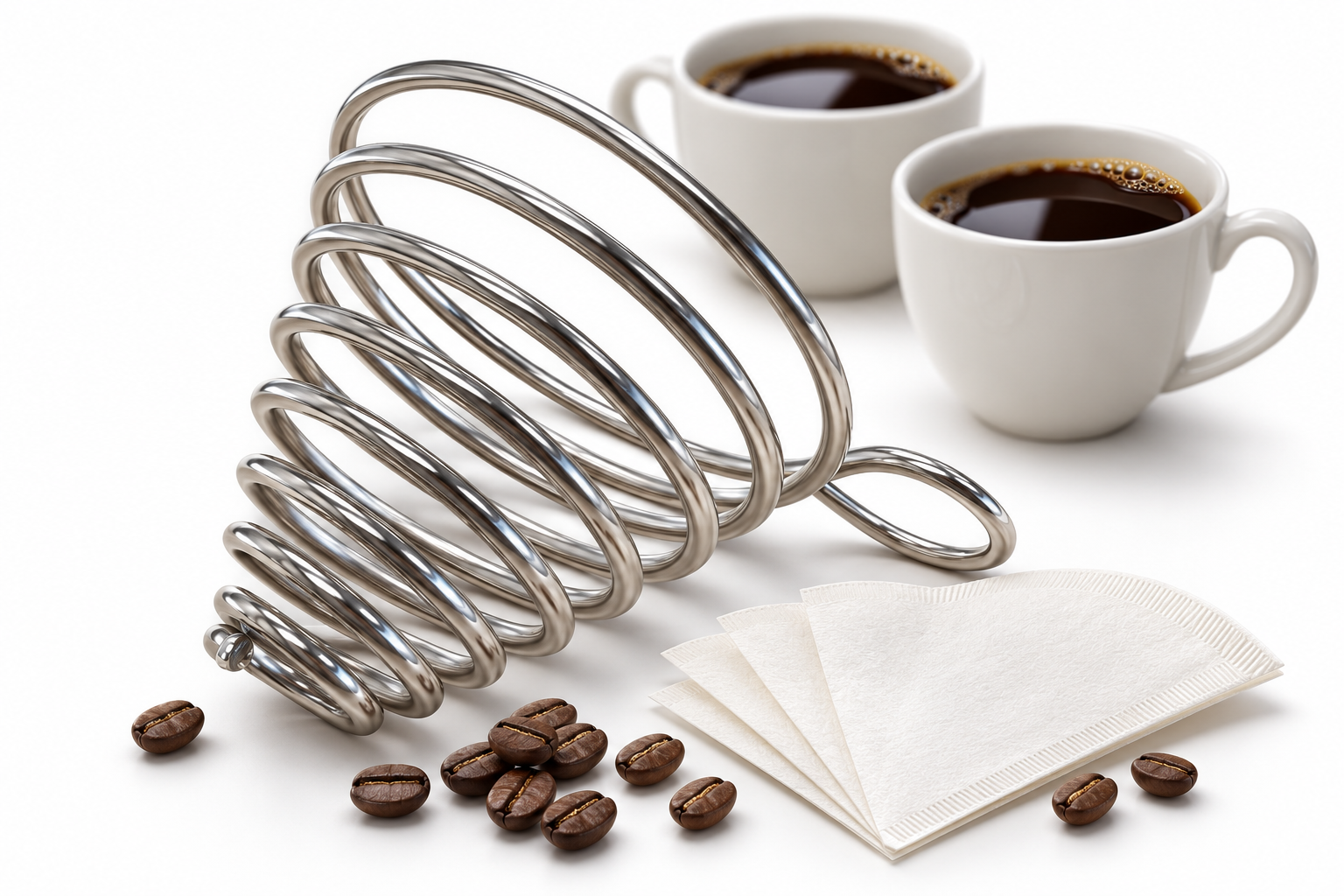
Bringing an original product to market often requires more than a promising concept. Designers must translate their ideas into physical components, evaluate prototypes, resolve manufacturing challenges, and determine whether production is financially practical. Custom spring product development can become especially challenging when the spring itself is central to the product’s design rather than simply a standard component within a larger assembly.
That was the situation facing Chuck Mack, an independent designer and founder of Chuck Mack Design, as he developed Lefty Coils, an innovative concept for pour-over coffee brewing. His project required a distinctive conical spring and wire form design that evolved through prototype development, engineering collaboration, and production planning.
Ace Wire Spring & Form Co., Inc., a custom spring product development manufacturer located near Pittsburgh, Pennsylvania, worked with Mack to help move his concept toward a manufacturable product. What began as an unusual spring design ultimately progressed into finished components delivered to a fulfillment center in Michigan, preparing Lefty Coils for commercial distribution.
The project demonstrates how practical engineering support, communication, and manufacturing flexibility can help independent inventors and product developers turn unconventional ideas into real products.
Lefty Coils began with Chuck Mack’s vision for a different approach to pour-over coffee brewing. Rather than developing another conventional dripper, Mack envisioned an immersive brewing concept built around a distinctive coil-shaped component.
The idea presented an interesting manufacturing challenge. A conical spring is not simply a straight cylindrical coil with a different appearance. Its changing diameter, coil geometry, end configuration, and relationship to surrounding components can introduce considerations that must be evaluated before consistent production is possible.
For a product like Lefty Coils, the formed wire component is a recognizable part of the design itself. That means the manufacturer must consider more than whether the spring can be produced. The finished geometry must also align with the designer’s intended product configuration and subsequent manufacturing steps.
Mack approached Ace Wire Spring with his concept and began working with the company’s engineering team to develop a practical path forward.
One of the most interesting aspects of the Lefty Coils project was the collaboration between an independent designer based in Reykjavik, Iceland, and a spring manufacturer in McKees Rocks, Pennsylvania.
Despite the distance, the project moved forward through direct email communication, drawing revisions, technical discussions, and prototype feedback. Mack worked closely with Ace design engineer Frank Santilli as the component evolved.
The process was not necessarily straightforward. As development progressed, the design became more complex than Mack had initially envisioned. Each adjustment required consideration of how the revised geometry could be manufactured and how it would affect the eventual production process.
That type of interaction is an important part of spring design assistance. A customer may understand exactly what a finished product should accomplish without knowing the most practical method of manufacturing every component. An experienced spring manufacturer can help identify the technical questions that must be resolved before production.
In correspondence with Ace, Mack specifically acknowledged the assistance he received from Frank and the positive experience of working through the project.
“Working with Frank has been a great help.”
For Ace, that feedback reflects the value of direct communication between the customer and the people evaluating how a component will actually be manufactured.
The Lefty Coils project illustrates why conical spring manufacturing can require careful evaluation when the component has a specialized shape or intended function.
Unlike a conventional cylindrical spring, a conical spring has a diameter that changes along its length. Depending on the design, this geometry may be selected for packaging, movement, appearance, or other application-specific requirements.
Manufacturing considerations can include wire diameter, coil spacing, the number of turns, the relationship between the largest and smallest diameters, and the configuration of the spring ends. When additional wire form features are incorporated into the component, their position and geometry must also be considered.
In the Lefty Coils project, revisions included attention to the coil configuration and a loop-style handle. These details were important enough to require continued discussion between the designer and Ace’s engineering team.
The challenge was not simply to reproduce a generic spring. It was to manufacture a custom formed-wire component that reflected the evolving requirements of an original consumer product.
That distinction matters for product developers. Standard catalog springs are often appropriate for established mechanical applications, but unusual product concepts may require geometry that cannot be obtained from an off-the-shelf component.
Ace manufactures custom springs and wire forms to customer specifications, allowing qualified projects to be evaluated around the actual design rather than limited to standard stock configurations.
Before committing to commercial production, Mack needed confidence that the design could be translated into a satisfactory physical component.
Spring prototype development provides that opportunity. A prototype allows the designer to evaluate the actual part, assess its geometry, identify necessary adjustments, and determine whether the design is ready for the next stage.
For Lefty Coils, prototype refinement was an important milestone. In August 2025, Mack informed Ace that he was satisfied with the prototype, although the process had taken longer and involved more complexity than he originally anticipated.
That experience is familiar in product development. A concept that appears straightforward during early planning may reveal additional requirements once a physical part is produced and evaluated.
Changes made during prototyping are not necessarily evidence that a project has gone wrong. They can be part of establishing a manufacturable design before committing to larger quantities.
The key is to resolve important questions while revisions are still practical.
For independent inventors and smaller product development companies, this stage can be especially valuable because a premature production commitment may consume resources before the final configuration has been validated.
The Lefty Coils project also demonstrates that a custom spring product development manufacturer may be one participant in a broader manufacturing process.
After the prototype stage, Mack still needed to coordinate additional operations, including welding and electropolishing, before the finished product could be prepared for sale.
Those requirements were separate considerations in the overall product development process. Ace’s role centered on engineering collaboration and manufacturing the custom spring components, while Mack remained responsible for coordinating the other steps necessary to complete his product.
This distinction is important for companies developing products with multiple manufacturing requirements.
A formed wire component may need to interface with fabricated parts, undergo finishing operations, or be incorporated into an assembly after leaving the spring manufacturer. These downstream requirements should be considered early because they can influence design decisions, production scheduling, and the information suppliers need to prepare accurate quotations.
The Lefty Coils experience shows why successful product development often depends on coordination among the designer, component manufacturer, finishing providers, and other suppliers.
Once a prototype has been developed, the next major question is often financial: How many components should be manufactured in the initial production run?
For custom springs, pricing is influenced by more than raw material. Machine setup, tooling considerations, manufacturing complexity, inspection, and order quantity can all affect the cost per component.
This creates a common challenge for independent inventors. Ordering too few parts may result in a relatively high unit cost, while ordering a large quantity before market demand is established can create unnecessary inventory risk.
During the Lefty Coils project, Mack and Ace discussed different production quantities and the relationship between setup costs, per-part pricing, and the budget available for an initial order.
Frank Santilli evaluated quantity options as part of those discussions, helping Mack consider a practical starting point for production.
This is an important example of how custom spring product development manufacturing differs from purchasing standard catalog components. Production quantity is not merely a purchasing detail. It can be a meaningful part of the overall manufacturing strategy.
For customers planning future releases, communicating estimated annual demand and potential repeat orders can also help a manufacturer understand the longer-term opportunity.
After months of design discussions, revisions, and production planning, Lefty Coils reached an important milestone.
On November 5, 2026, Chuck Mack informed Ace that the springs manufactured for his product had arrived at a fulfillment service center in Michigan and were expected to be ready for shipment shortly.
The update marked a significant transition. The project was no longer only an idea, a drawing, or a prototype being evaluated. Finished spring components had been manufactured and delivered into the distribution process for a new commercial product.
Mack also shared the launch of the Lefty Coils website, where customers could learn about the product. His initial distribution plans focused on the contiguous United States, with future production decisions dependent on how the first orders developed.
For an independent designer, reaching this stage represents considerable progress. Product development requires persistence through technical revisions, sourcing decisions, cost considerations, and the practical details of preparing a product for sale.
For Ace Wire Spring, the project provided another example of how a custom spring and wire form manufacturer can contribute to an application outside traditional industrial machinery.
The Lefty Coils concept also generated interest beyond the manufacturing process.
In February 2026, Mack shared an article from Barista Magazine discussing his coffee brewing concept. In the coverage, he acknowledged the engineering and production assistance involved in developing the product.
Although Ace was not identified by name in that reference, the recognition reinforced an important part of the story: bringing an original product to life often requires collaboration between the inventor and experienced manufacturing professionals.
By November 2026, Mack was also anticipating additional exposure through the magazine’s gift guide.
This interest illustrates how a specialized manufactured component can become part of a product with an audience far removed from the industries most commonly associated with spring manufacturing.
Ace routinely works with industrial and OEM applications, but the underlying manufacturing capabilities can also support qualified product development projects involving unique consumer products and specialty equipment.
The Lefty Coils experience offers several lessons for engineers, entrepreneurs, and companies developing products that require custom springs or wire forms.
First, an unconventional design should be evaluated for manufacturability before committing to a substantial production order. A spring may appear simple in a drawing but become more complicated when coil geometry, end features, tolerances, and production methods are considered together.
Second, communication between the designer and manufacturer can be just as important as the original specifications. In this project, continued correspondence allowed Mack and Ace to work through revisions and practical manufacturing questions without requiring in-person meetings.
Third, prototypes provide a valuable opportunity to refine the component before production. Mack’s satisfaction with the prototype was an important step, but it did not eliminate the need to coordinate finishing, costs, and other commercial considerations.
Finally, production planning should reflect the customer’s actual business situation. A new product entering the market may require a different quantity strategy than an established OEM purchasing thousands of components through a recurring program.
The objective is to establish a manufacturing approach that supports the product’s requirements and the customer’s realistic production plans.
Although Lefty Coils is a distinctive coffee brewing application, the engineering and manufacturing considerations are relevant to many other industries.
Product developers may require compression springs, extension springs, torsion springs, conical springs, or custom wire forms for mechanisms that cannot be assembled using standard components.
Some projects begin with a detailed engineering drawing. Others begin with a prototype, a physical sample, or an early concept that requires additional manufacturing review.
Ace Wire Spring provides spring design assistance and prototype support as part of qualified custom manufacturing opportunities. The company’s engineering and estimating teams can review drawings, component geometry, materials, tolerances, production quantities, and other requirements that affect manufacturability.
The goal is to help customers establish a practical path from their current design stage toward custom manufacturing.
As the Lefty Coils project demonstrates, that process may involve multiple revisions and ongoing discussions before the customer is ready to approve production.
Ace Wire Spring & Form Co., Inc. has manufactured custom springs and wire forms in the Pittsburgh, Pennsylvania area since 1939. The company is ISO 9001:2015 certified and supports customers across a wide range of industrial, commercial, and specialty applications.
Ace’s capabilities include custom compression springs, extension springs, torsion springs, specialty springs, and wire forms manufactured to customer specifications.
For qualified product development projects, the company can provide engineering feedback, prototype support, manufacturing feasibility review, and production quotations.
The Lefty Coils collaboration is an example of how those capabilities can support an independent inventor developing an original product with unusual formed-wire requirements.
Rather than simply supplying a standard component, Ace worked with the designer as the spring configuration evolved and eventually manufactured parts for the product’s commercial launch.
If your company is developing a new product that requires a custom spring or wire form, Ace Wire Spring can review the available information and determine whether the project fits its manufacturing capabilities.
Helpful information includes engineering drawings, CAD files, prototype samples, photographs, material requirements, expected quantities, and details about how the component must function within the finished product.
If the design is still being refined, explain which requirements are established and which remain under evaluation. This can help Ace identify the questions that need to be resolved before quoting or manufacturing.
For projects approaching production, include estimated initial order quantities and anticipated future demand.
Ace focuses on custom manufacturing opportunities rather than retail sales of individual stock springs. Providing a clear path toward prototype approval or production helps the engineering and estimating teams evaluate the request effectively.
The Lefty Coils story demonstrates that successful product development rarely happens in a single step.
Chuck Mack began with an original approach to pour-over coffee brewing and worked through the challenges of prototype development, engineering revisions, production pricing, and additional manufacturing requirements.
With assistance from Ace Wire Spring’s engineering team, including design engineer Frank Santilli, the project progressed from an evolving spring concept to manufactured components delivered for commercial distribution.
For Ace, the project reflects the value of combining spring manufacturing capabilities with practical engineering collaboration and a willingness to evaluate unusual applications.
For product developers, the lesson is equally important: the right manufacturing relationship can help transform an unconventional concept into a component that is ready for real-world production.
If your next product requires a custom spring, conical coil, or wire form, contact Ace Wire Spring to discuss your design, prototype requirements, and production goals.
Yes. Ace provides engineering and manufacturing assistance for qualified custom spring product development and wire form projects. Customers can submit drawings, samples, or available design information for review before moving toward prototypes or production.
A conical spring is a coil spring with a diameter that changes along its length, producing a tapered or cone-shaped configuration. Its specific geometry and function depend on the application and design requirements.
Ace manufactures custom wire forms for qualified applications, including specialized products outside traditional industrial equipment. Manufacturing feasibility depends on the geometry, material, tolerances, quantities, and other project requirements.
Yes. Many engineering and manufacturing discussions can take place through email, drawings, photographs, and other shared documentation. The Lefty Coils project involved collaboration between a designer in Iceland and Ace’s engineering team in Pennsylvania.
Prototypes allow customers to evaluate the component’s geometry, fit, and intended function before approving larger quantities. They can also reveal design changes that should be addressed before production.
Yes. Ace can quote appropriate quantities or quantity breaks for qualified projects. Setup costs, component complexity, and order volume can influence pricing, so discussing initial demand and potential repeat orders is useful.
Ace Wire Spring & Form Co., Inc., located in McKees Rocks, Pennsylvania, manufactured the custom springs for Chuck Mack’s Lefty Coils product. Ace also provided engineering collaboration during the development process.


"Where it’s always SPRINGTIME!"
Copyright © Ace WIre Spring & Form Company, Inc. All Rights Reserved. Pittsburgh Website Design by Higher Images.


