


We produce custom springs and wireforms. We do not stock standard parts.
We produce custom springs and wireforms. We do not stock standard parts.


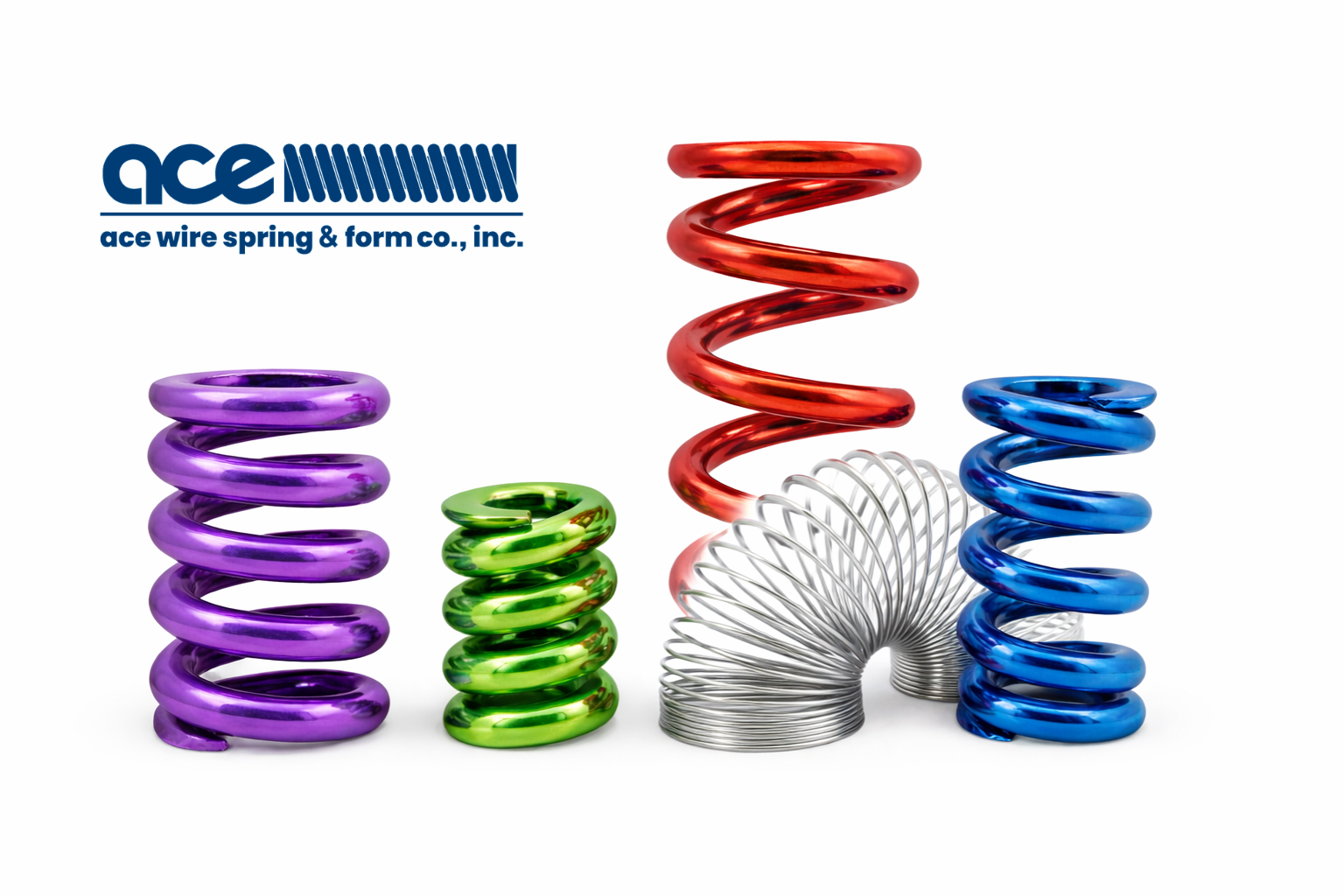
Many innovations come from careful engineering and precise design. Others happen completely by accident. One of the most famous examples is the creation of the Slinky, a toy that has sold hundreds of millions of units worldwide.
What many people do not realize is that the Slinky began as a spring design failure during a naval engineering project. The same mechanical principles used in this simple toy are still fundamental to modern spring engineering, from industrial equipment to medical devices.
Understanding how the Slinky was discovered also highlights an important lesson about springs. Even small changes in coil geometry, material selection, and load behavior can dramatically affect performance.
In the early 1940s, mechanical engineer Richard T. James was working on a project for the United States Navy. His task involved developing springs that could help stabilize sensitive instruments aboard naval ships.
During testing, James accidentally knocked a prototype spring off a shelf. Instead of simply falling to the ground, the spring began to “walk” forward as the coils transferred energy from one end to the other.
What appeared to be a faulty spring design immediately revealed an unusual mechanical behavior. The spring’s coil spacing, wire diameter, and flexibility allowed it to propagate motion along its length, creating the famous walking motion.
This unexpected behavior became the foundation for what would later be known as the Slinky.
After observing the unusual motion of the spring, James began experimenting with coil geometry and materials to reproduce the behavior consistently.
He eventually produced a tightly wound steel torsion spring with specific characteristics:
• Thin spring steel wire
• Large number of coils
• Uniform coil spacing
• Controlled tension between coils
These characteristics allowed the spring to stretch, compress, and transfer energy smoothly from one coil to the next.
In 1945, James and his wife Betty introduced the toy to the public under the name Slinky, a term chosen to describe the smooth, flowing motion of the spring.
The toy was first demonstrated at the Gimbels Department Store, where the entire inventory reportedly sold out within minutes.
The Slinky’s movement is not magic. It is the result of basic spring mechanics and energy transfer.
When one end of the spring moves downward, gravity and tension cause the coils to stretch. Energy transfers along the length of the spring as each coil pulls on the next.
This motion relies on several critical factors:
If any of these variables change, the motion may not occur at all. In fact, many early prototypes failed before the final design was perfected.
This highlights a key truth about spring engineering. Even simple springs depend on precise manufacturing tolerances and material control.
Although the Slinky is a toy, the engineering lessons behind it apply directly to modern manufacturing.
Today, springs are critical components in countless applications including:
In each case, the spring must perform reliably under very specific conditions. Engineers must account for load cycles, environmental exposure, material fatigue, and dimensional tolerances.
A small design change or manufacturing variation can dramatically alter how a spring behaves.
This is why experienced manufacturers often provide design assistance and prototyping support when developing custom springs.
The accidental discovery of the Slinky shows how much influence spring design can have on product performance.
Modern manufacturers now use advanced CNC coiling equipment, material testing, and quality systems to ensure springs perform exactly as expected in demanding applications.
For companies developing new products, early collaboration with a spring manufacturer can help identify potential performance issues before production begins.
This approach helps ensure springs deliver consistent performance whether they are used in industrial machinery, transportation systems, or consumer products.
What started as a dropped spring in a naval laboratory eventually became one of the most recognizable toys in the world.
The Slinky demonstrates that even the simplest mechanical components can produce remarkable results when the right combination of geometry, material, and engineering principles come together.
More importantly, it highlights why careful attention to spring design and manufacturing remains essential in modern engineering applications.


"Where it’s always SPRINGTIME!"
Copyright © Ace WIre Spring & Form Company, Inc. All Rights Reserved. Pittsburgh Website Design by Higher Images.


