

Elastic Modulus of Spring Design
Modulus of Eslasticity
The modulus of elasticity in tension and shear is vital to spring design. For most steels and age- hardenable alloys, the modulus varies as a function of chemical composition, cold work and degree of aging. Usually variations are small and can be compensated for by adjustment of reference parameters of the custom spring design, (e.g. number of active coils, and coil diameter).
For most materials, moduli are temperature-dependent and vary inversely with temperature by approximately 2% per 55°C (100°F). Since nonambient temperature testing is costly, design criteria should be specified at room temperature after having made appropriate compensation for the application temperature. Certain nickel-chromium-iron alloys are designed to have a constant modulus over the temperature range from -5° to 65°C (-50° to 150°F) and are exceptions to the above rule.
For true isotropic materials, the elastic moduli in tension (E) and shear (G) are related through Poisson's ratio by the expression: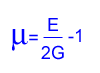
Magnetic Characteristics
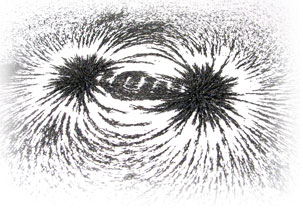 For most applications, the question of "magnetic or not" is adequately answered with the use of a permanent magnet. For some applications, even very low levels of magnetic behavior can be detrimental. Then, it is desirable to know the magnetic permeability of candidate materials and reach agreement between parties on a maximum allowable value. The table below lists approximate values for a number of low-permeability materials along with other frequently used alloys.
Materials |
Permeability at 200 Oersted, Room Temperature |
Air |
1 |
Brasses, Bronzes |
Nonmagnetic |
Carbon Steels |
> 500 |
Elgiloy® |
1.000035 |
Inconel Alloys: |
|
600 |
1.01 |
625 |
1.0006 |
X-750 |
1.0035 |
Stainless Steels: |
|
Type 301, spring temper |
> 30 |
Type 302, spring temper |
> 12 |
631 (17-7 PH) |
> 40 |
XM-28: Nitronic® 32* |
1.011 |
Nitronic® 50* |
1.004 |
Titanium Alloys |
Nonmagnetic |
* Nitrogen-strengthened manganese stainless steels.
|
|
Since permeability can be altered by cold work, some variation can be expected. In general, low-permeability materials are more expensive, so designers should specify low levels only when absolutely necessary. Often, nitrogen-strengthened manganese stainless steels are good choices because they have good strength at moderate cost.